RTD temperature sensor and voltagesignals. The units convert this input into isolated high level DC output, either as a voltage of 0-10V or current of 4-20mA. The CMS-BS100 is a multi-functional signal converter with multiple inputs 0,5°C. 010V DC or 0(4).20mA, short-circuit and overvoltage (24Vac/dc) protected.
What is an analog circuit?As we have learned in previous lessons, a discrete signal is simply an ON/OFF signal such as toggling a light switch. An analog signal is infinitely variable in theory between two points. A simple example of an analog device would be a dimmer switch that is used to raise and lower the brightness of a light.Types of analog circuits - The two most popular types of analog circuits are voltage and current.
Voltage signals are usually ±5 V, ±10 V, or 0 V to 5 V, and 0 V to 10 V. Current signals are usually 4 to 20 mA or 0 to 20 mA.Analog Voltage Circuits 0-10 VDC - Analog voltage circuits are the simplest as they are easiest to connect and troubleshoot. However they are not suited for most industrial environments where they may run beside motor circuits, solenoids, and other forms of electrical interference.Analog Current Circuits 4-20 mA - A 4-20mA signal is an analog signal that regulates a current loop to transmit a value from point A to point B. That is the simplest definition I can give. However, even it needs broken down a little more. Analog - As we have learned in previous lessons, a discrete signal is simply an ON/OFF signal such as toggling a light switch. An analog signal is infinitely variable in theory between two points.
A simple example of an analog device would be a dimmer switch that is used to raise and lower the brightness of a light. Current - The amount of electricity passing from point A to point B. Almost all other signals you will work with on industrial systems are based off of voltage or the potential electrical difference between two points. Make sure you read our to help you understand the terms power, voltage, current, resistance, and how they are associated.
Also read our to help you understand how to measure and troubleshoot 4-20mA circuits. Range - 4-20. Low 4mA - Unlike many analog signals, a 4-20mA signal's low end does not start at 0.
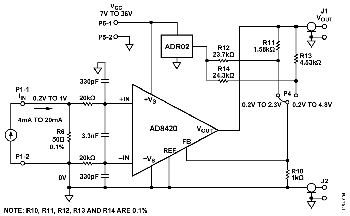
I am currently using a BOC Edwards Wide Range Vacuum gauge which generates a 2-10VDC signal, I need to convert this signal to 4-20mA to accomodate the data logger I am using. I am using a signal conditioner to convert the signal, but the scaling doesn't seem to be very accurate.
4 20ma Output Circuit
The signal conditioner accepts a 0-10VDC signal, outputs a 0-20mA signal, and is powered by a 24VDC power supply. My question is the instrument excitation is being drawn from the same power supply, and everything is sharing a common ground. The literature which is supplied with the gauge tells me to isolate the ground of the excitation and the signal. My signal conditioner board only has one ground connection. I originally had the ground for the power of the conditioner, the ground for the power of the gauge, and the ground for the signal all interconnected. Could someone suggest any way around this problem.
I am really a novice at instrumentation, but have been given the task of 'figuring it out'. Any help would be greatly appreciated.
The signal conditioner I am using is an Omega Om7 type conditioner. I found the user's manual for the OM7 backplanes and modules, which iswhat you are going to need to use because you will need to know thepinouts of those connectors to make this work.backplane is actually very similar to the 5B backplane that NIsells, and given your requirements I am a bit skeptical about thissetup being able to work with just one isolated current output module.The OM7 current output module expects its 0-10V input signal to bereferenced to the backplane's ground, and then it will output anisolated current.
This is the opposite of what you want, because youneed an isolated 0-10V input which will output a referenced 4-20mA.Here is what I think might work - you will need to use two signalconditioning modules cascaded together. You should first get anisolated voltage input module, which will convert the floating 0-10Vsignal into a referenced 0-10V signal.
Then take that voltage and sendit to the input of the isolated current output module, which willconvert your voltage into a 4-20mA signal.Good Luck,Logan Kunitz.